|
- Heat &
Fire Detection
- Over-Temperature
Control
- Suppression
Release Devices
-
- Popular
applications for Protection of:
- Schools,
Hospitals
- Warehouses
- Factories,
Ceilings
- Offices
- Computer
Rooms
- Libraries,
Museums
- Industrial
Fryers
- Spray
booths
- Transformer
Stations
- Central
Gas Heating Systems
- Gas Compressors
- Large
Gas Tanks
- Large
Oil Tanks
Datasheet
downloads :
|
|
GENERAL INFORMATION
DETECT-A-FIRE
units are the heart of many Fire Protection Systems. These highly
reliable devices have been a standard of the industry for over
45 years. Many hundreds of thousands of these units are now in
use controlling the release of fire suppression agents such as
FM200, CO2, water, foam, wet or dry chemicals. In some systems
the device is used as an ALARM device. to sense overheat or fire,
and alert personnel. In other systems, it is used as a RELEASE
device, to sense fire and actuate fire attack systems.

DETECT-A-FIRE
units have met with wide acceptance because they are designed
with RATE COMPENSATION. This provides a unique advantage over
both fixed temperature and rate-of-rise types of detectors because
only the DETECT-A-FIRE unit accurately senses the surrounding
air temperature regardless of the fire growth rate. At precisely
the predetermined danger point, the system is activated.
Fixed temperature detectors must be completely heated
to alarm temperature and therefore a disastrous lag in time may
occur with a fast rate fire. Rate-of-rise devices, on the other
hand, are triggered by the rate of increase in ambient temperature
and are subject to false alarms caused by harmless, transient
thermal gradients such as the rush of warm air from process ovens.
The secret of the unit's sensitivity is in the design. The outer
shell is made of a rapidly expanding alloy which closely follows
changes in surrounding air temperature. The inner struts are
made of a lower expanding alloy. Designed to resist thermal energy
absorption and sealed inside the shell, the struts follow temperature
changes more slowly.
A slow rate fire will heat the shell and struts together. At
the "set point", the unit will trigger, actuating the
alarm or releasing the extinguishant.
A transient rush of warm air up to 40ºF /min. may expand
the shell, but not enough to trigger the unit. By ignoring transient
warm air excursions, the DETECT-A-FIRE unit virtually eliminates
false alarms prevalent with rate-of-rise devices.
 If a fast rate fire starts,
the shell will expand rapidly. The struts will close, actuating
the alarm or releasing the agent. The faster the fire rate of
growth, the sooner the DETECT-A-FIRE unit will react. If a fast rate fire starts,
the shell will expand rapidly. The struts will close, actuating
the alarm or releasing the agent. The faster the fire rate of
growth, the sooner the DETECT-A-FIRE unit will react.
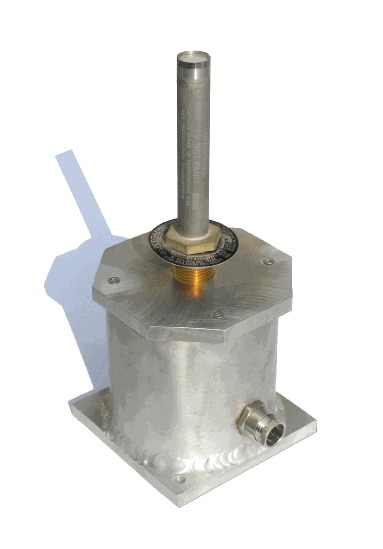
The DETECT-A-FIRE also can be delivered
as a part of a complete systen, built in an Ex-safe junction/mounting
box. Ex-Certificates available: |
|
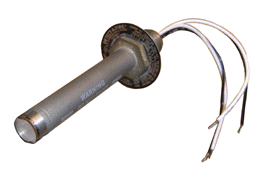
VERTICAL DETECT-A-FIRE UNITS
Vertical detectors are designed for use
in both "ordinary" or "harzardous" locations.
For "ordinary" use, they may be mounted to any approved
junction box with 7/8 inch diameter opening by using 1/2 14 NPT
mounting nuts. The device may be wired in or out of conduit,
depending on local preference and codes. Four leadwires are provided
on normally open vertical units (that close on temperature rise),
per UL requirement, to facilitate supervision of system wiring.
Units available in 2-wire and 4-wire-versions.
Instruments are Underwriters Laboratory and Underwriters Laboratory
of Canada listed and Factory Mutual approved for hazardous locations,
when mounted in a suitable fitting. |
|
  HORIZONTAL
DETECT-A-FIRE UNITS HORIZONTAL
DETECT-A-FIRE UNITS
Horizontal Heat detectors are designed
for locations where appearance is a factor. The attractive, functional
design lends physical protection of the unit while making it
suitable for commercial, industrial, mercantile and public buildings,
institutions and ships in non-hazardous locations (those classified
as "ordinary" under the National Electric Code). Flush
mounted units are designed to fit standard 4 inch octagonal electrical
boxes and surface mounting units are designed to mount directly
on ceilings or on 4 inch electrical junction boxes. Canadian
Electrical Code requires mounting only to an electrical junction
box. |